
Two factories can receive the same brief and look equally good on paper, and the only reliable way to separate them is a side-by-side comparison on fixed criteria before any money moves. The comparison is cheap to run — one brief, one scoring table, two site calls — and it exposes almost every difference that later becomes an argument. The goal is not to find a perfect factory; it is to find the factory that is honest about its own limits.
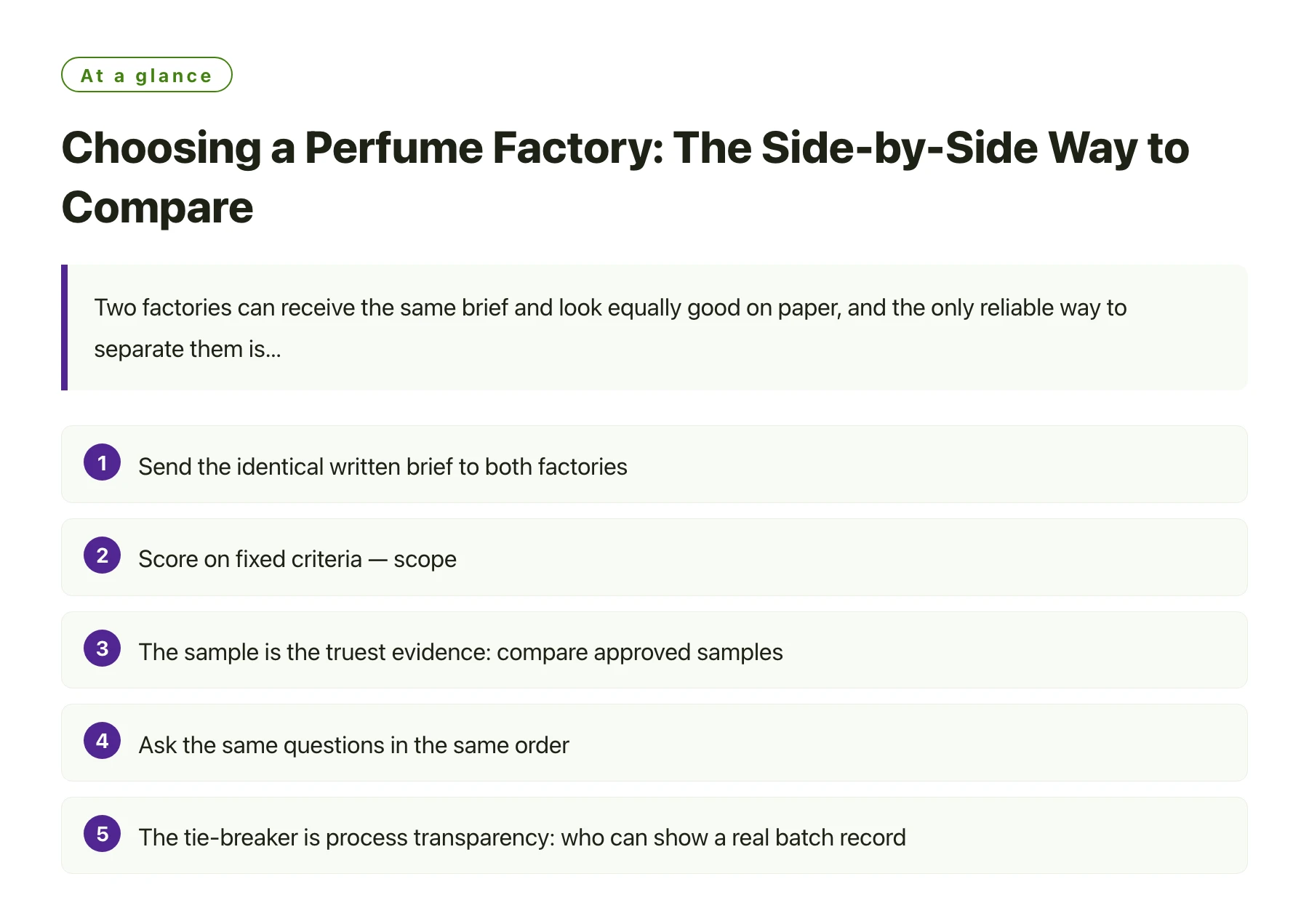
Key takeawaysSend the identical written brief to both factories, because comparisons only mean something when the input is the same. · Score on fixed criteria — scope, certifications, sample process, minimums, lead times, documentation — and put the scores in one table. · The sample is the truest evidence: compare approved samples, batch records and reports, not sales talk. · Ask the same questions in the same order, and let the factories answer in writing. · The tie-breaker is process transparency: who can show a real batch record, and who only has anecdotes.
Choosing a perfume factory is the one decision in a fragrance project where a bad outcome is expensive to reverse — the formula, the bottle and the minimum order all lock in at once. Yet most founders choose on the strength of a single sales call.
The alternative is deliberately boring: run two candidates through the same brief, score them on the same table, and let the differences talk. This article shows what that comparison looks like and how to read it.
Neither factory in the example below is real; the pattern is. Factory A behaves like a classic contract manufacturer, Factory B like a private-label specialist, and the table shows why the same brief produces different answers.
Build the comparison before you start calling
A comparison needs three fixed things: one written brief, a list of criteria, and a score table. Write the brief once — fragrance family, oil percentage, packaging type, quantities, destination market — and send it identically to both candidates.
Decide the criteria before you hear any answers; otherwise every interesting sales call silently rewrites the list. In the example below, the two candidates took opposite positions: Factory A positions itself as an OEM partner for perfume brands and builds its story on process depth, while Factory B sells speed and off-the-shelf designs an OEM partner for perfume brands.
Keep everything in writing. Verbal answers are impressions; written answers are documents you can score and re-read when the relationship has aged six months.
Factory A versus Factory B on the same brief
| Check | Factory A | Factory B |
|---|---|---|
| In-house steps | Compounding, filling, decoration, testing in house | Filling and packing in house; decoration partly subcontracted |
| Certifications | Cosmetics GMP plus market-specific certificates | Basic set; newer certificates still pending |
| Sample process | Written approval with a retained sample | Photographic approval |
| Stability data | Full programme, shared with batch records | Short screen; full report only on request |
| Minimum order | Higher, justified by packaging tooling | Lower, but with a separate tooling invoice |
| Lead time | Twelve weeks, quoted with a written calendar | Eight weeks, quoted verbally |
| Documentation | Complete pack in the first email | Reassembled after the deposit |
Read the two columns as answers, not verdicts. Factory A is not automatically the better choice — if the project is a short-lived trend product, Factory B's speed and lower minimum may win on fit. The table exists to surface trade-offs, not to automate the decision.
Reading the differences
Three rows deserve extra attention. Certification: a certificate is only as good as its issuer, so verify numbers with the issuing body — cosmetics GMP and product safety testing are documented by the laboratories and bodies that run them [1].
The sample and stability rows: photographic approval caused more small-brand disputes than almost anything else in the category — an approval should be a physical retained reference, not an image in a chat — and a stability programme has to fit the destination market. For EU markets, the commission's cosmetic ingredient database tells you which restricted lists a compliant formula has to respect [2].
Formulation compliance is a live topic in the industry press, because the rules keep moving; a factory that follows regulatory change is a factory that will not code a discontinued material into your formula on day two [3]. Concentrate compliance starts with the IFRA standards, which restrict individual fragrance ingredients, so ask how the formula will be checked against the current limits before it goes to production [4].
Everything above is a detail of one bigger question — what to check before choosing a perfume factory — and the side-by-side method is simply that checklist made visible what to check before choosing a perfume factory.
What breaks the tie
If the scores are close, reverse the questions. Ask each factory what could go wrong with your project on its line, and listen for a specific risk followed by a specific control; that answer describes real process, while a blanket reassurance describes a hope.
This is also where the longer checklist of choosing the right factory for a perfume brand pays off: after the scores, the decision comes down to who can show you a real batch record from raw material intake to release, and who can only tell you about one choosing the right factory for a perfume brand.
Take the winner for a small first order before committing to a large program. A first run that matches the comparison is the strongest possible confirmation; one that does not is the cheapest lesson available.
If both factories score evenly, reverse the question: ask each what could go wrong with your project on their line. The one who answers with a specific risk and a specific control is describing real process; the one who answers with reassurance is describing a hope.
Sources
- SGS: Cosmetics, Personal Care & Household Testing —— Testing, inspection and certification services for cosmetics and personal care, including microbiological, stability and safety testing aligned with cosmetics GMP.
- EU CosIng — Cosmetic Ingredient Database (European Commission) —— The European Commission's CosIng database of cosmetic ingredients, listing ingredient functions, restrictions and labelling requirements under EU cosmetics law.
- Cosmetics Business —— A trade publication covering the beauty and cosmetics industry, including fragrance launches and regulatory developments.
- IFRA Standards Library (International Fragrance Association) —— The IFRA Standards Library lists the restrictions the fragrance industry applies to individual fragrance ingredients, based on safety assessments; it is the reference point for compliant fragrance formulation.
Frequently asked questions
How many factories should I compare side by side?
Two or three is usually enough. The method's value is the fixed criteria, not the sample size — one factory compared with itself over two rounds tells you less than two factories compared on one table.
What is the first question to ask a shortlisted factory?
Ask for the written scope: which steps are performed in house and which are subcontracted. Everything else — price, lead time, quality — sits on top of that answer.
How do I verify a factory's certifications?
Take the certificate number, the issuing body and the scope, and check with the issuer directly. Certificates in a brochure are decoration; certificates you verified are evidence.
Should the sample be the deciding factor?
The sample decides the scent, not the partnership. Judge the factory on the batch records, stability data and documents behind the sample, and judge the scent on the sample itself.
Can a cheaper factory become a good partner later?
Sometimes, but the pattern is usually set in the first order. Use the first run as the test: if the process was as described, the second order is routine; if not, the gap will only widen.
Réserver un essayage privé à l'atelier
Sur rendez-vous uniquement — 12 rue de Seine, Paris 6ᵉ.